What Is an Impacted Tooth? Why Some Teeth Never Fully Erupt
Learn what an impacted tooth is, why teeth become trapped beneath the gums, common symptoms, diagnostic methods, and available treatment options.

Not every tooth emerges into the mouth at the expected time. Sometimes, a tooth remains partially or completely trapped beneath the gum tissue or within the jawbone. This condition is known as an impacted tooth.
An impacted tooth may not always cause noticeable symptoms. Some people discover the condition only during a routine dental examination or when dental imaging reveals a tooth that has not erupted properly.
However, depending on its position, an impacted tooth can sometimes affect nearby teeth, contribute to discomfort, or create other oral health concerns.
Understanding why teeth become impacted, how dentists identify the condition, and when treatment may be necessary can help patients make informed decisions about their dental health.
What Is an Impacted Tooth?
An impacted tooth is a tooth that cannot fully emerge into its expected position in the mouth because something is obstructing its eruption or because it is developing in an abnormal direction.
A tooth may remain entirely beneath the gum tissue or become partially visible.
Impaction can occur in different areas of the mouth, although certain teeth are more commonly affected than others.
The condition is frequently associated with wisdom teeth, but other teeth can also become impacted, particularly the upper canine teeth.
An impacted tooth does not always require immediate removal. The appropriate approach depends on its position, development, symptoms, and potential effect on neighboring teeth.
Why Do Some Teeth Become Impacted?
Tooth eruption is a natural developmental process involving the movement of teeth from their developing positions within the jaw toward the oral cavity.
Several factors can interfere with this process.
1. Not Enough Space in the Dental Arch
One of the common reasons for tooth impaction is insufficient space.
When the jaw does not have enough room to accommodate an erupting tooth, the tooth may remain trapped or develop at an angle.
This is frequently seen with wisdom teeth, which are the last permanent teeth to emerge.
2. Abnormal Tooth Position
Sometimes, a tooth develops at an unusual angle or in a position that prevents it from following its normal eruption path.
For example, an upper canine may grow toward the roof of the mouth or toward the roots of neighboring teeth instead of moving into its expected position.
3. Physical Obstruction
An erupting tooth may encounter an obstruction that prevents it from reaching the surface.
Possible obstructions include:
- Extra teeth, also known as supernumerary teeth.
- Certain cysts or other growths.
- Dense or unusually positioned bone.
- Retained primary teeth.
- Other structural abnormalities.
The obstruction may interfere with the tooth’s natural eruption pathway.
4. Developmental Factors
Some teeth may develop differently because of inherited or developmental factors.
These differences can influence the position, timing, and direction of eruption.
In certain cases, the exact cause of impaction cannot be identified.
Which Teeth Are Most Commonly Impacted?
Although any tooth can potentially become impacted, some teeth are more frequently affected.
Wisdom Teeth
Wisdom teeth, or third molars, are among the most commonly impacted teeth.
They usually emerge during late adolescence or early adulthood. However, limited space at the back of the jaw may prevent them from erupting completely.
An impacted wisdom tooth may remain beneath the gums, emerge at an angle, or become partially visible.
Not every impacted wisdom tooth needs to be removed. The dentist evaluates its position, condition, and potential risks before recommending treatment.
Upper Canine Teeth
Upper canine teeth are also relatively susceptible to impaction.
These teeth are important for biting and contribute to the shape and appearance of the smile.
When an upper canine becomes impacted, it may remain beneath the gum tissue or develop toward the roof of the mouth.
In some cases, orthodontic treatment and a surgical procedure may be used together to guide the tooth into its proper position.
Premolars
Premolars, located between the canine teeth and molars, can also become impacted.
This may happen when there is insufficient space or when an obstruction interferes with their eruption.
Other Permanent Teeth
Although less common, other permanent teeth may fail to erupt normally.
The appropriate treatment depends on the location of the tooth and the reason it has not emerged.
What Are the Signs and Symptoms of an Impacted Tooth?
Some impacted teeth do not cause symptoms, particularly when they remain completely beneath the gum tissue and do not affect nearby structures.
However, other cases may produce noticeable changes.
Common signs include:
Pain or tenderness: An impacted tooth may cause discomfort in the surrounding gum or jaw, especially if inflammation develops.
Swollen gums: The gum tissue around a partially erupted tooth may become red, tender, or swollen.
Difficulty opening the mouth: In certain cases, inflammation around an impacted tooth may make jaw movement uncomfortable.
Unpleasant taste or bad breath: Food debris and bacteria can accumulate around a partially erupted tooth, particularly when the area is difficult to clean.
Visible partial eruption: A small portion of the tooth may appear through the gums without fully emerging.
Pressure on neighboring teeth: An impacted tooth may come into contact with adjacent teeth or affect their surrounding structures.
These symptoms do not necessarily confirm impaction. A dental examination is needed to identify the actual cause.
Can an Impacted Tooth Affect the Other Teeth?
Yes. Depending on its position, an impacted tooth may affect the surrounding teeth and supporting structures.
Some possible complications include:
Damage to Neighboring Tooth Roots
An impacted tooth may press against or come into contact with the root of an adjacent tooth.
In certain cases, this can contribute to root resorption, a process in which part of the neighboring tooth root is lost.
This is one reason why dentists may recommend imaging to evaluate the relationship between an impacted tooth and nearby structures.
Increased Risk of Localized Gum Problems
Partially erupted teeth can create areas where food and bacteria collect.
These spaces may be difficult to clean properly and can contribute to localized gum inflammation or infection.
Development of Cysts
In some cases, a fluid-filled sac called a dentigerous cyst can develop around the crown of an unerupted tooth.
Although not every impacted tooth develops a cyst, this possibility is one reason why certain impacted teeth require monitoring.
Changes to Nearby Dental Structures
An impacted tooth may affect the position or surrounding structures of adjacent teeth, depending on its orientation and the available space.
However, impaction does not automatically cause crowding or movement of other teeth. Each case needs to be evaluated individually.
How Do Dentists Diagnose an Impacted Tooth?
A visual examination may reveal signs of an impacted tooth, but dental imaging is often necessary to determine its exact position.
The dentist evaluates both the visible portion of the mouth and the structures beneath the gums.
1. Clinical Examination
The dentist examines the dental arch and checks whether an expected tooth is missing from its usual position.
They may also look for swollen gum tissue, partial eruption, or signs of inflammation.
2. Panoramic Dental X-Ray
A panoramic X-ray provides a broad image of the upper and lower jaws.
It can help identify unerupted teeth, evaluate their general position, and show how they relate to neighboring teeth.
This imaging method is commonly used when assessing impacted wisdom teeth and other unerupted teeth.
3. CBCT Imaging
Cone Beam Computed Tomography, commonly called CBCT, produces detailed three-dimensional images of dental structures.
It may be recommended when a more precise understanding of the tooth’s position is necessary.
For example, CBCT can help evaluate the relationship between an impacted tooth, adjacent roots, and nearby anatomical structures.
It is not required for every case. The dentist determines whether additional imaging is clinically justified.
What Are the Treatment Options for an Impacted Tooth?
Treatment depends on the type of tooth involved, its position, the patient’s age, and whether complications are present.
Not every impacted tooth requires removal.
1. Monitoring and Observation
If an impacted tooth is not causing symptoms or damaging nearby structures, the dentist may recommend periodic monitoring.
This involves checking the tooth’s position and surrounding tissues during routine dental visits.
Additional imaging may be recommended when necessary to identify changes.
2. Surgical Extraction
Surgical extraction may be recommended when an impacted tooth causes recurring problems or presents a significant risk to surrounding structures.
The procedure involves accessing the tooth through the gum tissue and, in some cases, removing a small amount of surrounding bone to facilitate removal.
The complexity depends on the tooth’s position and the surrounding anatomy.
3. Surgical Exposure and Orthodontic Treatment
For certain impacted canine teeth, preserving the natural tooth may be possible.
The dentist or oral surgeon may perform a procedure to expose the tooth by removing a small amount of gum tissue or bone covering it.
An orthodontic attachment may then be connected to the tooth so that braces or another orthodontic appliance can gradually guide it into the correct position.
This approach requires careful planning and coordination between the dental professionals involved.
4. Removal of an Obstruction
If another tooth or a structural obstruction is preventing normal eruption, treatment may involve removing the obstruction.
In selected cases, this may allow the impacted tooth to erupt naturally or with orthodontic assistance.
The appropriate approach depends on the underlying cause.
Does Every Impacted Tooth Need to Be Removed?
No. Removal is not automatically necessary for every impacted tooth.
Some impacted teeth remain stable and do not cause pain, infection, damage, or other complications.
In these cases, the dentist may recommend monitoring rather than immediate treatment.
However, removal or another intervention may be considered when an impacted tooth:
- Causes recurring inflammation or infection.
- Damages the roots of neighboring teeth.
- Is associated with a cyst or other pathological change.
- Interferes with planned orthodontic treatment.
- Causes persistent discomfort.
- Presents a significant risk to surrounding structures.
The decision should be based on clinical findings rather than the presence of impaction alone.
Can an Impacted Tooth Erupt on Its Own?
Sometimes. Whether an impacted tooth can erupt naturally depends on its position, the amount of available space, its stage of development, and whether an obstruction is present.
A partially erupted tooth may continue emerging if the conditions allow it.
However, a tooth that is severely angled, blocked, or positioned deeply within the jaw may be less likely to erupt without intervention.
In selected cases, orthodontic treatment can help guide an impacted tooth into its proper position.
Your dentist can evaluate the tooth and explain whether observation, orthodontic assistance, or another treatment is appropriate.
Why Early Evaluation Matters
An impacted tooth may remain unnoticed for years because it does not always cause obvious symptoms.
However, identifying its position early can help dentists monitor its development and determine whether intervention is necessary.
This is particularly important for younger patients with developing permanent teeth, as treatment options may depend on the tooth’s stage of development.
Routine dental examinations and appropriate imaging allow dentists to identify unerupted teeth and evaluate their potential effects on surrounding structures.
Get an Impacted Tooth Evaluated at Crown Dental Group
An impacted tooth does not always require surgery, but it should be properly assessed to determine whether it is affecting your oral health.
At Crown Dental Group, patients can receive dental examinations and discuss appropriate treatment options for concerns involving unerupted teeth, wisdom teeth, and other dental conditions.
Whether you have noticed a tooth that has not fully emerged or an X-ray has revealed an impacted tooth, a professional evaluation can help determine the appropriate next step.
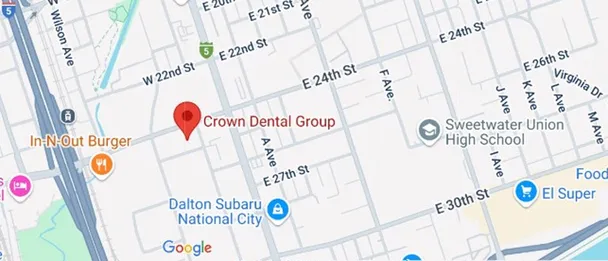
Crown Dental Group serves patients in National City and nearby communities, including Chula Vista, Bonita, and Imperial Beach.
Schedule a dental examination to have your impacted tooth evaluated.
- Crown Dental Group
- 2405 Transportation Ave
- National City, CA 91950
- Phone: (619) 474-6200
- Email: info@crowndentalnc.com
Frequently Asked Questions About Impacted Teeth
1. Can an impacted tooth cause pain?
Yes, but not always. Some impacted teeth remain painless, while others may cause discomfort, swelling, or tenderness, particularly when inflammation or infection develops around the area.
2. Can an impacted tooth damage neighboring teeth?
Yes. Depending on its position, an impacted tooth may place pressure on nearby structures or contribute to root resorption in an adjacent tooth. Dental imaging helps evaluate these relationships.
3. Do all impacted teeth need surgery?
No. Some impacted teeth can be monitored if they are not causing symptoms or damaging surrounding structures. Surgery may be recommended when complications develop or the tooth presents a significant risk.
4. What is the difference between an impacted and partially erupted tooth?
An impacted tooth is unable to fully emerge into its expected position. A partially erupted tooth has emerged through the gums but remains only partly visible. A partially erupted tooth may still be considered impacted if something prevents complete eruption.
5. Can braces fix an impacted tooth?
In certain cases, yes. An impacted canine or another suitable tooth may be surgically exposed and gradually guided into position using braces or other orthodontic appliances. Not every impacted tooth can be treated this way.
6. How do dentists know if a tooth is impacted?
Dentists examine the mouth and may use panoramic X-rays or CBCT imaging to identify teeth that have not erupted normally. Imaging helps determine the tooth’s position and relationship with surrounding structures.
7. Can an impacted tooth become infected?
Yes. A partially erupted impacted tooth may create an area where food particles and bacteria collect. This can contribute to localized gum inflammation or infection. An evaluation is important if swelling, pain, or other symptoms develop.
8. Can an impacted tooth be left untreated?
Some impacted teeth can be safely monitored, provided they are not causing problems or showing concerning changes. Regular dental examinations help determine whether continued observation is appropriate or treatment is needed.
Find us here