What Happens When a Child Loses a Baby Tooth Too Early? Understanding Dental Space Maintainers
Learn why baby teeth matter, what happens when a child loses one too early, and how dental space maintainers help guide permanent teeth.
Losing baby teeth is a normal part of childhood development. As children grow, their primary teeth gradually loosen and fall out to make room for permanent teeth. However, when a baby tooth is lost earlier than expected, it can create a problem that parents may not immediately recognize.
Baby teeth do more than help children chew and speak. They also help maintain the space needed for permanent teeth to emerge in their proper positions.
When a primary tooth is lost prematurely, nearby teeth may gradually shift into the empty space. This can reduce the room available for the permanent tooth that is supposed to replace it.
In certain situations, a dentist may recommend a dental space maintainer to help preserve that space until the permanent tooth is ready to erupt.
Understanding how space maintainers work can help parents make informed decisions about their child’s dental development.
Why Are Baby Teeth Important?
Baby teeth, also known as primary teeth or milk teeth, are the first set of teeth that develop during childhood.
Although they eventually fall out, they play several important roles in a child’s growth and oral development.
They Help Children Chew Properly
Primary teeth allow children to bite and chew a variety of foods as they transition to a more diverse diet.
Healthy baby teeth support normal eating habits and help children develop comfortable chewing patterns.
They Support Speech Development
Teeth help the tongue and lips produce certain sounds. Missing teeth, particularly front teeth, may temporarily affect how a child pronounces some words.
They Maintain Space for Permanent Teeth
One of the most important functions of baby teeth is maintaining the space needed for permanent teeth.
As permanent teeth develop beneath the gums, the primary teeth help guide their eventual eruption.
When a baby tooth is lost too early, nearby teeth may move into the open space. This can interfere with the position or eruption of the permanent tooth.
They Support Jaw and Dental Development
Primary teeth contribute to the development of a child’s bite and the arrangement of the dental arches.
Keeping them healthy until they are naturally ready to fall out helps support the transition to permanent teeth.
What Does It Mean When a Baby Tooth Is Lost Too Early?
A baby tooth is considered prematurely lost when it falls out or needs to be removed significantly earlier than expected.
The timing matters because permanent teeth do not all erupt at the same age.
For example, primary molars generally remain in place for several years while the permanent teeth beneath them continue developing.
If one of these teeth is lost too early, the neighboring teeth may begin moving toward the empty space before the permanent replacement tooth is ready to emerge.
This may reduce the space available for the developing permanent tooth.
Not every early tooth loss requires a space maintainer. The dentist must evaluate which tooth was lost, the child’s age, the development of the permanent tooth, and the condition of the surrounding teeth.
What Causes a Child to Lose a Baby Tooth Prematurely?
Several dental conditions can cause a primary tooth to be lost before its expected time.
1. Extensive Tooth Decay
Untreated cavities can progress and destroy significant portions of a baby tooth.
If the tooth becomes too damaged to restore, extraction may be necessary.
This is one reason why primary teeth still require regular dental care, even though they are temporary.
2. Dental Trauma
Falls, sports injuries, and accidents can damage or dislodge baby teeth.
Depending on the severity of the injury, a tooth may become loose, displaced, fractured, or require removal.
Any significant dental injury in a child should be evaluated by a dentist.
3. Dental Infection
An infection involving a primary tooth may damage the surrounding tissues and affect the tooth’s long-term prognosis.
Depending on the extent of the problem, treatment may involve pulp therapy or extraction.
4. Developmental or Dental Conditions
Certain developmental differences or dental conditions may affect when primary teeth are lost.
A dentist can assess whether the timing of tooth loss is within the expected range or whether additional monitoring is necessary.
What Happens If a Baby Tooth Is Lost Too Early?
The most important concern is the possibility of losing space in the dental arch.
When a primary tooth is removed, the surrounding teeth may gradually shift toward the empty area.
For example, if a child loses a baby molar prematurely, the neighboring tooth may move forward into the gap. This can reduce the space available for the permanent premolar that will eventually replace the missing tooth.
Depending on the circumstances, early tooth loss may contribute to:
- Reduced space for permanent teeth.
- Changes in the position of neighboring teeth.
- Crowding during permanent tooth eruption.
- Altered eruption paths.
- Increased complexity in future orthodontic treatment.
However, these outcomes are not inevitable. The likelihood of space loss depends on the child’s dental development, the location of the missing tooth, and the amount of time before the permanent tooth erupts.
This is why an early dental evaluation is important after premature tooth loss.
What Is a Dental Space Maintainer?
A dental space maintainer is an appliance designed to preserve the space left by a prematurely lost baby tooth.
It helps prevent nearby teeth from moving into the empty area before the permanent tooth is ready to erupt.
Space maintainers may be fixed or removable, depending on the child’s needs and the location of the missing tooth.
They do not create additional space or directly move teeth into new positions. Their main purpose is to help maintain the existing space during the transition from primary to permanent teeth.
What Are the Different Types of Dental Space Maintainers?
The type of space maintainer recommended depends on which tooth is missing, how many spaces need to be preserved, and the child’s stage of dental development.
1. Band and Loop Space Maintainer
A band and loop appliance is commonly used when a single baby molar is lost prematurely.
It consists of a metal band placed around a neighboring tooth and a loop that extends across the missing tooth space.
The loop helps prevent the adjacent teeth from moving into the gap.
2. Crown and Loop Space Maintainer
This appliance is similar to a band and loop space maintainer, but it uses a crown fitted over a supporting tooth.
It may be considered when the supporting primary tooth requires significant restoration and needs additional coverage.
3. Distal Shoe Space Maintainer
A distal shoe appliance may be used when a second primary molar is lost before the first permanent molar has erupted.
Its design helps guide the position of the erupting permanent molar.
Because this appliance extends beneath the gum tissue, it requires careful planning and follow-up.
4. Lingual Holding Arch
A lingual holding arch is a fixed appliance generally used in the lower jaw when multiple primary teeth have been lost and certain permanent teeth are already present.
It uses bands on supporting molars connected by a wire positioned along the inside of the lower teeth.
The appliance helps maintain space across a larger portion of the dental arch.
5. Removable Space Maintainer
A removable space maintainer resembles a small dental appliance that can be taken out for cleaning.
It may be considered in selected cases, depending on the child’s age, cooperation, and the number and location of missing teeth.
Your dentist will determine whether a fixed or removable design is appropriate.
How Does a Dental Space Maintainer Work?
A space maintainer works by occupying or preserving the area left by a missing primary tooth.
Without an appliance, neighboring teeth may gradually shift toward the empty space. This movement can reduce the room available for the permanent tooth.
A properly designed space maintainer helps resist that movement while the permanent tooth continues developing.
The appliance does not force the permanent tooth to erupt faster. Instead, it helps preserve the available space until the tooth is ready to emerge naturally.
Once the permanent tooth begins erupting and the space maintainer is no longer needed, the dentist can remove or replace the appliance as appropriate.
What Happens During Space Maintainer Placement?
Getting a space maintainer usually involves several steps.
Step 1: Dental Examination
The dentist examines the child’s teeth, gums, and bite.
They will identify which primary tooth was lost and evaluate the surrounding teeth.
Step 2: Evaluating Permanent Tooth Development
Dental X-rays may be used to check the position and development of the permanent tooth beneath the gums.
This helps the dentist determine whether a space maintainer is necessary and which design may be appropriate.
Step 3: Preparing the Supporting Tooth
Depending on the appliance, the dentist may prepare a neighboring tooth or select an appropriate supporting surface.
For a band and loop appliance, a metal band is fitted around the supporting tooth.
Step 4: Fabricating and Placing the Appliance
The space maintainer is made or selected to fit the child’s dental structure.
The dentist checks the fit and confirms that it preserves the intended space without interfering with the child’s bite.
Step 5: Follow-Up Monitoring
Regular visits allow the dentist to check the appliance, monitor the child’s dental development, and determine when it should be removed.
Follow-up is especially important because the child’s mouth continues changing as permanent teeth erupt.
Does a Dental Space Maintainer Hurt?
Space maintainers are generally designed to fit comfortably and should not cause significant pain when properly placed.
A child may initially notice the appliance because it feels unfamiliar. Mild pressure or temporary irritation may also occur while adjusting to it.
However, persistent pain, swelling, or an appliance that feels loose should be checked by a dentist.
Parents should avoid attempting to bend, remove, or repair a fixed space maintainer at home.
How Should Parents Care for a Child’s Space Maintainer?
Proper maintenance helps prevent plaque buildup and protects the supporting teeth.
Parents can help children follow these care practices:
- Brush twice daily using an age-appropriate fluoride toothpaste.
- Clean carefully around the appliance and supporting teeth.
- Follow the dentist’s instructions for flossing.
- Avoid sticky foods such as chewing gum and caramel.
- Limit very hard foods that could damage or dislodge the appliance.
- Attend scheduled dental appointments.
- Contact the dental office if the appliance becomes loose, damaged, or uncomfortable.
Children may need assistance with brushing and flossing, especially when they are still developing their oral hygiene skills.
How Long Does a Child Need to Wear a Space Maintainer?
The length of time varies depending on the child’s dental development and the location of the missing tooth.
Some children may need an appliance for several months, while others may require it for a longer period.
The dentist monitors the development of the permanent tooth and determines when the space maintainer is no longer necessary.
It should not be removed simply because the child has become accustomed to wearing it. Removing it too early may allow neighboring teeth to shift into the space.
Does Every Child Who Loses a Baby Tooth Need a Space Maintainer?
No. A space maintainer is not automatically required whenever a baby tooth is lost.
Several factors influence the decision, including:
- The child’s age.
- Which primary tooth was lost.
- How much time remains before the permanent tooth erupts.
- The position and development of the permanent tooth.
- The condition of the surrounding teeth.
- Whether there is already sufficient space in the dental arch.
For example, if the permanent replacement tooth is close to erupting, a space maintainer may not be necessary.
A dentist can evaluate these factors and recommend monitoring or an appliance based on the child’s individual needs.
Protect Your Child’s Developing Smile at Crown Dental Group
Baby teeth play an important role in a child’s oral development. When one is lost earlier than expected, understanding whether the space needs to be preserved can help prevent avoidable complications as permanent teeth begin to emerge.
At Crown Dental Group, parents can discuss their child’s dental concerns and receive guidance on appropriate preventive and restorative care.
If your child has lost a baby tooth prematurely, schedule a dental evaluation to determine whether a space maintainer or another treatment approach may be appropriate.
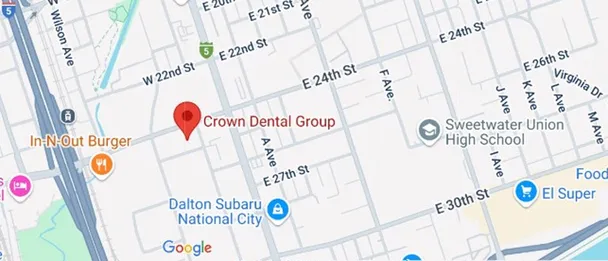
Crown Dental Group serves families in National City and nearby communities, including Chula Vista, Bonita, and Imperial Beach.
Schedule a dental appointment to support your child’s developing smile.
- Crown Dental Group
- 2405 Transportation Ave
- National City, CA 91950
- Phone: (619) 474-6200
- Email: info@crowndentalnc.com
Frequently Asked Questions About Dental Space Maintainers
1. At what age can a child get a dental space maintainer?
There is no single age requirement. Space maintainers may be recommended when a child loses a primary tooth prematurely and the permanent replacement tooth is not yet ready to erupt. The dentist evaluates the child’s dental development before recommending treatment.
2. Does every missing baby tooth require a space maintainer?
No. Some spaces do not need an appliance, particularly when the permanent tooth is close to erupting or there is sufficient space in the dental arch. The decision depends on the tooth involved and the child’s development.
3. Can a space maintainer move teeth into the correct position?
No. Its primary purpose is to preserve existing space, not actively move teeth. If a child develops significant alignment problems, orthodontic evaluation may be needed.
4. Can my child eat normally with a space maintainer?
Most children can continue eating normally, although some adjustments may be necessary. Sticky and very hard foods should generally be avoided because they may loosen or damage the appliance.
5. How do I know if my child’s space maintainer is loose?
You may notice that the appliance moves, feels different, or no longer sits properly. Your child may also complain of discomfort. Contact the dentist if you suspect the appliance is loose or damaged.
6. Can a space maintainer prevent braces in the future?
Not necessarily. A space maintainer helps preserve room for permanent teeth, but it cannot guarantee that a child will not need orthodontic treatment. Future alignment depends on several factors, including jaw development, tooth size, and natural eruption patterns.
7. How often should a child with a space maintainer visit the dentist?
Follow-up appointments should be scheduled according to the dentist’s recommendations. Regular monitoring allows the dentist to check the appliance, examine the supporting teeth, and track the eruption of permanent teeth.
8. What happens when the permanent tooth starts coming in?
The dentist evaluates whether the appliance is still needed. Once the permanent tooth is ready to erupt into the preserved space, the space maintainer may be removed or adjusted as appropriate.
Find us here