The Complete Clinical and Aesthetic Guide to Dental Implants, All-on-4, and All-on-6 in National City, CA
Restore missing teeth permanently with advanced Dental Implants, All-on-4, and All-on-6 at Crown Dental Group in National City, CA. Call (619) 474-6200.
Tooth loss—whether caused by severe periodontal disease, deep dental decay, root fractures, or physical trauma—is a life-altering experience. Beyond the immediate physical challenges of chewing and speaking clearly, missing teeth carry a heavy emotional and psychological burden. Patients frequently experience diminished self-esteem, feel anxious during social meals, and find themselves hiding their smiles behind their hands.
Furthermore, beneath the surface of the gums, missing teeth initiate a progressive biological decline: without the natural mechanical stimulation of tooth roots, the surrounding jawbone begins to resorb and shrink away. Over time, this loss of bone volume leads to premature facial collapse, sunken cheeks, and the shifting of remaining teeth.
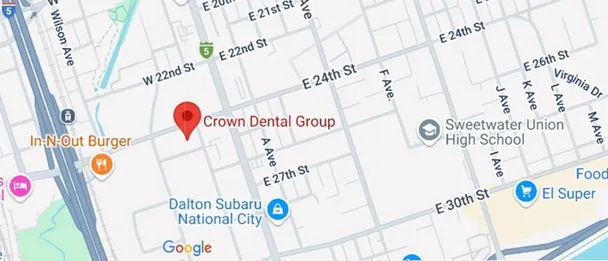
At Crown Dental Group, located at 2405 Transportation Ave, National City, CA 91950, we specialize in stopping bone loss and permanently restoring smiles using state-of-the-art dental implant therapy. Whether you need to replace a single missing front tooth or require full-arch reconstruction using advanced All-on-4 or All-on-6 same-day implant techniques, our practice combines 3D CBCT digital diagnostics with high-grade biocompatible titanium and zirconia to rebuild your oral health from the foundation up.
The Clinical & Biological Science: Osseointegration and Bone Biomechanics
Understanding how dental implants work requires looking closely at bone biology, material engineering, and the physiological response of human jaw tissue to artificial root structures.
The Biology of Osseointegration: Titanium Micro-Structure
Unlike traditional bridges or removable dentures that sit on top of the gums, a dental implant replaces the actual root structure of a missing tooth. The success of a modern dental implant hinges on a biological phenomenon known as osseointegration—the direct structural and functional connection between living bone tissue and the surface of a load-bearing synthetic implant.
- Titanium Grade 4 & Titanium Alloys (Ti-6Al-4V): Titanium is unique because the human body does not recognize it as a foreign entity. When titanium is exposed to air or fluid, it instantly forms a microscopic, highly stable layer of titanium oxide. This oxide layer is biologically inert, preventing corrosion and allowing osteoblasts (bone-forming cells) to attach directly to the implant fixture.
- Surface Topography Optimization (SLA Technology): Modern implants are not smooth metal screws; they undergo Sandblasted, Large-grit, Acid-etched (SLA) surface treatment. This creates a porous microscopic landscape that increases the contact surface area by hundreds of percent. Blood platelets immediately migrate into these micro-pores, releasing growth factors that accelerate osteogenesis (new bone formation).
Bone Mechanics: Stopping Resorption via Wolff’s Law
Why does the jawbone shrink when teeth are lost? The answer lies in Wolff’s Law, a fundamental principle of biomechanics stating that bone in a healthy person or animal adapts to the loads under which it is placed.
- Mechanical Stimulation: When you chew on a natural tooth, micro-strains travel down the periodontal ligament and root into the alveolar bone. This mechanical pressure signals osteoblasts to continuously rebuild the bone matrix.
- The Resorption Spiral: When a tooth is extracted or lost, stimulation ceases entirely. The body interprets the unused bone tissue as metabolically redundant and begins breaking it down. Within the first 12 months following tooth loss, up to 25% of the surrounding bone width can be permanently lost.
- Preservation via Implants: A titanium dental implant acts as an artificial root, transferring chewing forces directly into the maxilla or mandible. This restores functional mechanical stress to the surrounding bone cells, halting bone loss and preserving your natural facial profile.
Single Tooth Implants vs. Full-Arch All-on-4 / All-on-6 Solutions
Different degrees of tooth loss require distinct clinical approaches. At Crown Dental Group, we tailor your treatment to restore both individual gaps and full arches.
Single & Multi-Tooth Implants
For patients missing one or a few isolated teeth, single implants provide an aesthetic and non-destructive solution. Unlike traditional dental bridges—which require grinding down neighboring healthy teeth to serve as support anchors—a single dental implant leaves adjoining natural teeth completely untouched and intact.
Full-Arch Restoration: All-on-4 and All-on-6 Architecture
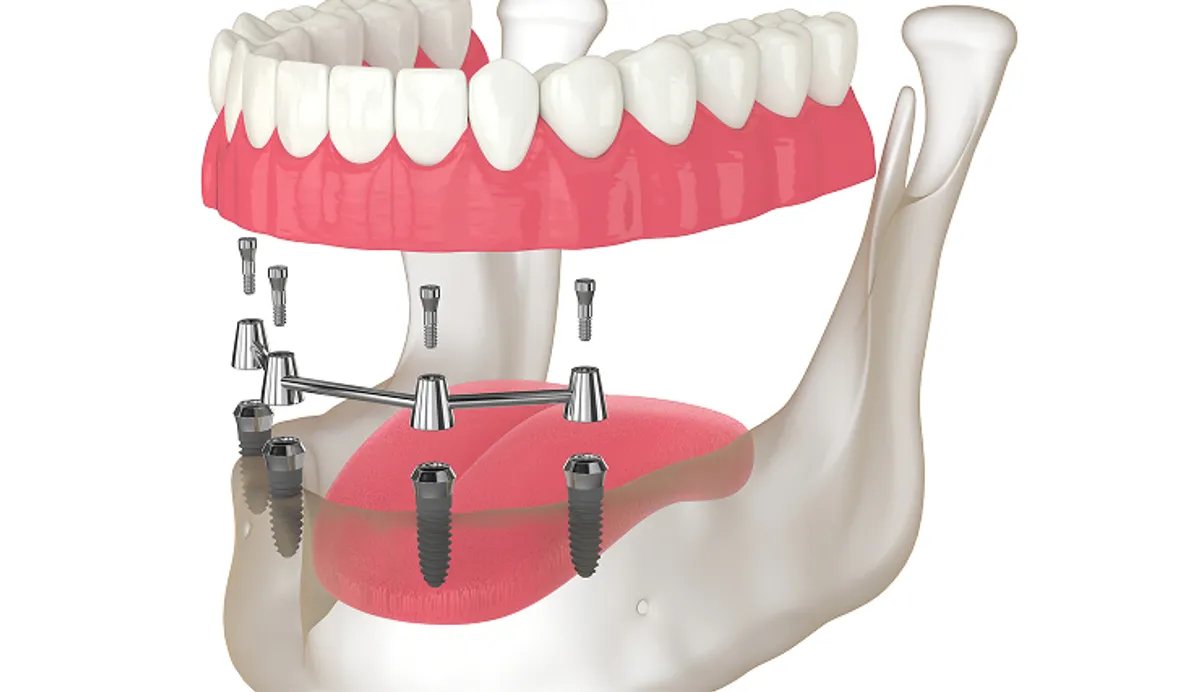
For patients suffering from total tooth loss (edentulism), severe advanced gum disease, or failing extensive crown work, replacing teeth one-by-one is neither efficient nor cost-effective. All-on-4 and All-on-6 techniques allow us to replace an entire upper or lower arch of teeth using just four to six strategically positioned implants.
- Angled Posterior Placement: In an All-on-4 procedure, the two anterior implants are placed vertically, while the two posterior implants are placed at an angle of 30 to 45 degrees. This tilted design utilizes the denser bone available in the front of the jaw, frequently bypassing the need for sinus lifts or extensive bone grafting.
- All-on-6 for Greater Occlusal Load Distribution: Adding two additional implants (All-on-6) distributes chewing forces across six anchor points instead of four. This is especially beneficial for patients with strong jaw muscles, larger bone structures, or a history of nocturnal teeth grinding.
- Immediate Load (“Same Day Teeth”): By rigidly splinting the implants together using a rigid provisional bridge on the day of surgery, we achieve immediate mechanical stability. You can enter our office with failing teeth and leave the same afternoon with a fully functional, beautiful fixed set of temporary teeth.
Step-by-Step Patient Journey at Crown Dental Group
A successful implant procedure relies on precise digital planning and meticulous surgical execution. Here is what you can expect during your treatment journey at our National City practice.
Phase 1: 3D CBCT Imaging and Digital Surgical Simulation
Your treatment begins with a comprehensive evaluation using our advanced Cone Beam Computed Tomography (CBCT) technology:
- Volumetric 3D Diagnostics: The CBCT scan generates high-resolution, three-dimensional views of your jawbone density, bone height, nerve pathways (such as the inferior alveolar nerve), and sinus cavities.
- Digital Implant Planning: Using specialized surgical software, we pre-plan the exact depth, angle, and position of every implant fixture down to the millimeter before stepping into the surgical suite.
Phase 2: Surgical Placement and Computer-Guided Precision
- Patient Comfort: Local anesthesia or specialized sedation options ensure you remain comfortable throughout the procedure.
- Guided Surgery: A custom 3D-printed surgical guide is placed over your gums, allowing us to insert the titanium fixtures through micro-incisions with surgical accuracy.
- Provisional Delivery: For same-day implant cases (such as All-on-4), your custom provisional teeth are secured to the implants immediately following placement.
Phase 3: Osseointegration and Custom Restorative Delivery
Over the next 3 to 6 months, osteoblasts actively deposit fresh bone matrix into the titanium SLA micro-surface, locking the implants permanently into your jawbone. Once osseointegration is confirmed:
- Digital Scanning: Intraoral digital scanners capture the spatial relationship of your healed implants without messy impression material.
- Master Fabrication: Our master technicians engineer your final prosthesis out of dense, high-translucency monolithic zirconia—a virtually unbreakable material that will not chip, crack, or stain.
- Final Securing: Your final custom prosthetic bridge or single crowns are securely attached, completely restoring your bite force, aesthetics, and confidence.
Frequently Asked Questions (FAQs) About Dental Implants
Q1: Is dental implant surgery painful?
Most patients are pleasantly surprised by how comfortable the procedure is. The surgery is performed under effective local anesthesia, so you feel no pain during placement. Post-operative discomfort is typically minimal and easily managed with over-the-counter pain medications like ibuprofen for 2 to 4 days.
Q2: What is the success rate of dental implants?
Dental implants have a documented long-term clinical success rate of 95% to 98%. Factors that contribute to optimal healing include good bone quality, meticulous surgical planning with 3D CBCT imaging, non-smoking status, and disciplined daily home care.
Q3: Am I a candidate for dental implants if I already have bone loss?
Yes! Even if you have experienced bone loss since losing your teeth, options are available. Techniques like bone grafting, sinus lifts, or utilizing angled implants (such as in All-on-4) allow us to place implants securely into available bone structures.
Q4: How do I clean and maintain my All-on-4 implants?
Maintaining All-on-4 implants is simple:
- Brush twice daily with a soft-bristled electric toothbrush.
- Use a water flosser (Waterpik) to gently flush away food debris from under the prosthetic bridge.
- Visit Crown Dental Group every 6 months for professional hygiene evaluations and maintenance.
Q5: How long do dental implants last?
The titanium implant fixture placed in your bone is designed to last a lifetime with proper care. The custom zirconia crown or bridge attached on top undergoes normal daily wear and may occasionally require adjustment or polishing after 15 to 20+ years.
Q6: What is the difference between All-on-4 and traditional dentures?
Traditional dentures rest on top of the gums, relying on adhesives and suction; they frequently slip, cause sore spots, and restore only about 20% of natural chewing power. All-on-4 implants are fixed permanently into your bone—they do not move, do not require sticky glues, and restore up to 90% of natural chewing force.
Q7: Can dental implants stain or develop cavities?
No. Dental implants and monolithic zirconia restorations are composed of non-porous biocompatible materials that cannot develop tooth decay or absorb stains from coffee, tea, or food. However, keeping the surrounding gum tissue clean is still essential to prevent gum inflammation (peri-implantitis).
Q8: How long does the entire dental implant process take?
The timeline varies depending on your individual treatment plan. A straightforward single implant typically takes 3 to 4 months from initial placement to final crown delivery. Complex cases requiring extensive grafting or full-arch restorations may take 4 to 6 months to ensure complete, safe osseointegration.
Schedule Your Dental Implant Consultation Today
You don’t have to suffer from missing teeth, loose dentures, or difficulty chewing your favorite foods. Reclaim your smile, your health, and your confidence with permanent dental implant solutions from Crown Dental Group.
Call our dedicated team today to reserve your personalized implant consultation and 3D imaging evaluation!
- Practice Name: Crown Dental Group
- Address: 2405 Transportation Ave, National City, CA 91950
- Phone: (619) 474-6200
- Email: info@crowndentalnc.com
- Service Area: National City, Chula Vista, Bonita, Imperial Beach, San Ysidro, and South Bay San Diego.
Take the first step toward a restored smile—call (619) 474-6200 or email info@crowndentalnc.com to schedule your appointment!
Find us here