The Pediatric Blueprint: Cultivating a Lifetime of Health in National City
Start your child's health journey at Crown Dental Group. Comprehensive pediatric and family dentistry in National City for smiles that last a lifetime.
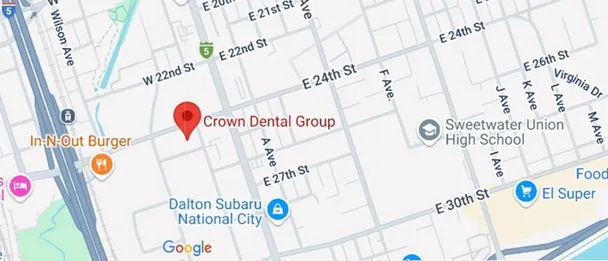
Pediatric dentistry is not just “small adult” dentistry; it is the management of a rapidly evolving biological system. From the moment the first primary tooth erupts to the shedding of the last baby tooth, your child’s mouth is a construction site of bone, nerves, and soft tissue. At Crown Dental Group, located at 2405 Transportation Ave, we specialize in the unique clinical needs of the developing jaw.
The Importance of Primary Teeth
A common misconception among parents in Chula Vista and National City is that primary teeth “don’t matter” because they eventually fall out. In reality, primary teeth serve as the placeholders for the permanent dentition.
The Spacing Sentinel
Think of baby teeth as the “GPS” for adult teeth—they hold the exact amount of lateral and vertical space required for the larger permanent teeth to emerge. If a baby tooth is lost prematurely to decay or trauma, the surrounding teeth will naturally tilt and shift into the empty gap. This “space loss” can lead to:
- Impaction: Where the adult tooth becomes stuck beneath the bone.
- Crowding: Creating crooked smiles that require years of expensive orthodontic intervention.
- Speech Impediments: Primary teeth are essential for proper tongue placement during the formation of “s,” “t,” and “th” sounds.
Clinical Prevention: Sealants and Remineralization
Our preventative program for children utilizes high-tech barriers to stop decay before it penetrates the dentin. In the coastal climate of San Diego County, sugary snacks and acidic beverages are everywhere; our goal is to create a “chemical armor” for your child’s enamel.
Dental Sealants: The Invisible Shield
We apply a medical-grade resin to the deep pits and fissures of the 6-year and 12-year molars. These grooves are often narrower than a single toothbrush bristle—physically impossible to clean at home, regardless of how well a child brushes.
- The Procedure: Non-invasive and requires no drilling.
- The Result: A smooth surface that seals out food particles and acid-producing bacteria. Studies show sealants reduce the risk of decay in molars by nearly 80%.
Silver Diamine Fluoride (SDF): Modern Non-Invasive Care
For our youngest or most nervous patients, we can sometimes treat active decay without a drill using Silver Diamine Fluoride (SDF):
- The Silver: Acts as an antimicrobial agent that kills the bacteria causing the cavity.
- The Fluoride: Remineralizes the tooth structure to prevent further breakdown.
- The “Freeze”: It effectively stops the cavity in its tracks, allowing us to delay more invasive fillings until the child is older and more cooperative.
The Psychological Journey: The “Happy Visit”
We know that a negative experience at a young age can lead to a lifetime of dental anxiety. Our office, situated near the Kimball Park area, is designed to be a sanctuary. We believe that the first visit should not be about “fixing” a problem—it should be about building a relationship.
The “Tell-Show-Do” Technique
Fear usually stems from the unknown. Our clinicians are trained in behavioral guidance techniques that demystify the dental environment:
- Tell: We explain the tools in kid-friendly language. We don’t use “needles” or “drills”; we use “sleepy juice” and “whistle tools.”
- Show: We demonstrate how the tool works on a fingernail or a puppet, and let children see the “tooth camera” and “Mr. Thirsty” (suction).
- Do: Only after the child is comfortable do we proceed with the clinical task.
Nutrition and the Oral Microbiome
National City families are busy, and convenience often dictates diet. However, the oral microbiome—the community of bacteria living in your child’s mouth—is highly sensitive to the frequency of sugar intake.
The “Frequency vs. Quantity” Rule
It is a biological fact that it’s not how much sugar your child eats, but how often. Every time sugar enters the mouth, bacteria produce acid for approximately 20 minutes.
- The Snacker: A child who sips juice over three hours subjects their teeth to constant acid attacks.
- The Treater: A child who eats a candy bar in five minutes and then rinses with water allows the mouth’s pH levels to stabilize quickly.
We work with parents to identify “hidden” sugars in snacks like fruit leathers, granola bars, and sports drinks—products marketed as healthy but devastating to primary enamel.
Orthodontic Interception: Early Detection
Why Age 7?
We follow the American Association of Orthodontists’ recommendation that children have their first orthodontic evaluation by age 7. At this stage, the jaw is still growing and highly “plastic,” allowing us to identify structural issues early:
- Crossbites: Which can cause the jaw to grow lopsided.
- Overbites/Underbites: Which can affect chewing and facial symmetry.
- Airway Issues: Narrow arches can lead to mouth breathing and poor sleep, which often mimics ADHD symptoms in the classroom.
Advanced Pediatric Diagnostics: Beyond the Naked Eye
Digital Radiography and Safety
We utilize Digital Radiography, which reduces radiation exposure by up to 80–90% compared to traditional film X-rays. These images allow us to see between the teeth where cavities often hide in children who don’t yet floss consistently, and to monitor the path of eruption for permanent teeth—ensuring no extra or missing teeth disrupt the bite.
Intraoral Cameras: A Child’s-Eye View
Small, wand-like cameras take high-resolution photos of the inside of your child’s mouth. Seeing a cavity on a large monitor makes the importance of brushing far more real than simply being told it’s there—and we use these images to track wear patterns and early decay signs over time.
Specialized Care for Infants: The Age One Visit
The American Academy of Pediatric Dentistry recommends the first visit by the first birthday. For infants, we perform a “Knee-to-Knee” Exam—the parent and dentist sit facing each other with their knees touching, forming a table for the baby. This allows for rapid assessment of the gums, frenums, and emerging teeth, plus lip and tongue-tie screening that can affect breastfeeding and later speech development.
Emergency Pediatric Care: What to Do in a Crisis
The Knocked-Out Permanent Tooth
Time is the most critical factor. Handle the tooth by the crown (not the root), rinse gently with water only, and try to re-insert it in the socket. If that isn’t possible, place it in cold milk and call us immediately. If we can see the child within 30–60 minutes, there is a high chance of saving the tooth.
Cracked or Chipped Teeth
Even a small chip can expose the sensitive inner pulp of the tooth. If your child chips a tooth, try to find the fragment—we can sometimes bond the original piece back onto the tooth for a seamless repair.
Habit Counseling: Thumb Sucking and Pacifiers
Non-nutritive sucking is natural for infants, but if it continues past age 3 or 4, it can cause open bites or V-shaped arches. Our approach is supportive, not shaming:
- Positive Reinforcement: We provide habit trackers and reward systems.
- Appliance Therapy: A small, comfortable orthodontic appliance can physically remind the child not to suck their thumb, allowing the jaw to return to its natural shape.
- Parental Guidance: We help parents identify the triggers—stress and tiredness—that lead to the habit, offering a holistic path to stopping.
The Link Between Oral Health and Academic Success
Millions of school hours are lost each year due to dental-related pain. A child with a low-grade toothache cannot focus on a math test, and children with visible decay are less likely to participate in class discussions or social activities. By maintaining a “Dental Home” at Crown Dental Group, you are ensuring your child has one less barrier to succeeding in the classroom.
Call Crown Dental Group in National City today to schedule your child’s “Happy Visit” and begin building a lifetime of healthy smiles at 2405 Transportation Ave, National City, CA 91950.
Find us here